
Ho Chi Minh City · Foreign Buyer Guide
Buying property in Ho Chi Minh City as a foreigner
The four districts that anchor the foreign-buyer market, the quota mechanics in practice, the major developers and the pricing reality. The Latitude editorial guide for Saigon in 2026.
01
Why Ho Chi Minh City
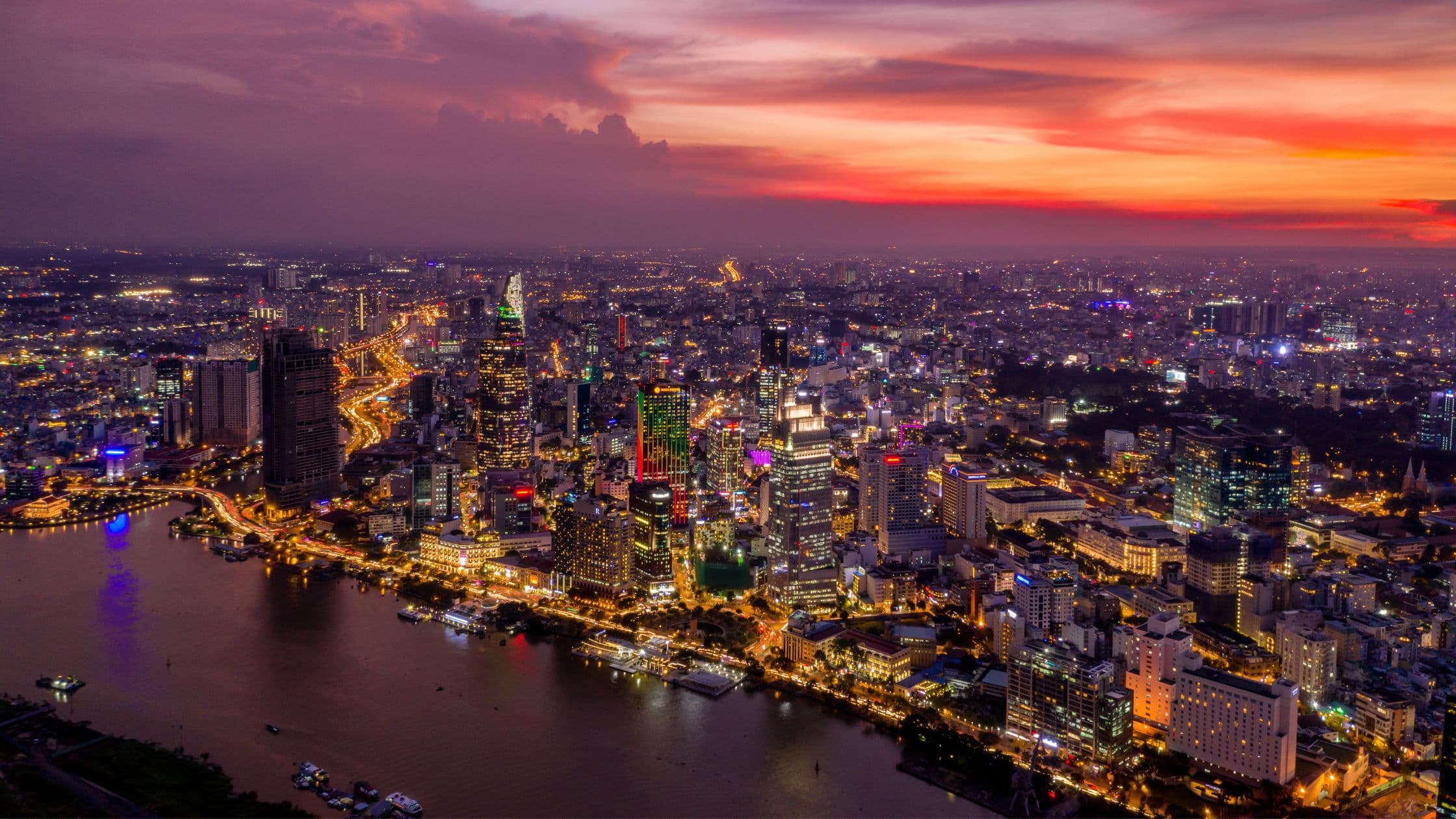
Ho Chi Minh City, still called Saigon by most who live in it, is Vietnam's economic capital and the country's deepest foreign-buyer property market. The premium residential pipeline concentrates in three corridors with a fourth emerging: the colonial-grid core of District 1, the planned Thu Thiem peninsula across the Saigon River in District 2, the Singapore-master-developed Phu My Hung in District 7, and the gentrifying riverfront of District 4 on the southern edge of District 1.
The structural case for a Saigon condo purchase has three threads. First, the institutional pipeline is maturing — Vinhomes, Masterise, Phu My Hung, Novaland, Khang Dien and CapitaLand Vietnam are all delivering at international specification. Second, the foreign-buyer-eligible inventory in District 1 is structurally scarce because central HCMC has little developable land. Third, the rental market is deep and broker-led, with serviced apartment and long-stay lease demand absorbing supply at predictable rates.
02
The four districts that matter
Foreign buyers concentrate in four areas. Each trades on a different logic and a different buyer profile.
District 1: the colonial core
The historic centre. Opera House, Notre Dame Cathedral, Saigon River, Ben Thanh Market and the densest cluster of fine dining, hotels and embassy infrastructure in Vietnam. Premium new-launch pricing USD 5,000 to 9,000 per square metre. Foreign quota is the tightest in the country and frequently exhausted at launch. Most buyers here are capital-preservation oriented; rental yield is secondary. The Marina Central complex from Masterise Homes anchors the most recent ultra-premium launches.
District 2: Thu Thiem peninsula
The planned 657-hectare new central business district across the Saigon River from District 1, connected by the Thu Thiem 2 Bridge and the under-construction Metro Line 1. Vinhomes Golden River and the Empire City masterplan deliver new institutional product at the premium end. Pricing USD 4,500 to 8,000 per square metre. The Thu Thiem story is a 10 to 20 year build-out; early-mover buyers are betting on the maturation arc rather than current amenity density.
District 7: Phu My Hung
The Singapore-style masterplanned township south of District 1, developed by the Vietnamese-Taiwanese Phu My Hung Development Corporation since the 1990s. Established schools (Saigon South International, the Korean School, the Japanese School), parks, shopping and a deep Korean, Japanese and Taiwanese expat population. Pricing USD 3,000 to 5,500 per square metre. The mature low-rise townhouse and condo inventory trades on lifestyle and family-friendly practical infrastructure rather than headline price.
District 4: the gentrifying frontier
Historically working-class, directly south across a short canal from District 1. The Saigon Royal and Sunwah Pearl projects opened up the riverfront edge of the district to foreign buyers in the late 2010s. Pricing USD 3,500 to 5,500 per square metre, with further upside if Metro Line 4 lands on the projected schedule. The bet here is location-arbitrage: District 1 distance and view at a District-non-1 price.
03
Quota mechanics in practice
The Law on Housing 2014 caps foreign ownership at 30 percent of units per apartment building. In HCMC premium new launches this cap is the binding constraint, not a theoretical limit. Hong Kong, Singapore and Taiwan buyers move within 48 to 72 hours of sales opening. By week three of a launch the foreign-eligible inventory is typically gone in District 1 and Thu Thiem.
Practical buyer behaviour: register interest with the developer's foreign sales channel weeks before launch, line up the inward foreign-currency transfer documentation in advance, and have the SPA legal review pre-briefed so the offer can convert to signed contract within the week-one window. Reserving without committing rarely works at this end of the market.
04
The major developers
The HCMC foreign-eligible market is concentrated. Five names cover roughly 60 percent of premium pipeline.
Vinhomes (Vingroup): the largest, with the Vinhomes Central Park, Vinhomes Golden River and Vinhomes Grand Park masterplans. Institutional product with consistent build quality and the deepest after-sales infrastructure in the market.
Masterise Homes: the premium upmarket player, with branded-residence partnerships including Marriott International. Marina Central is the current flagship.
Phu My Hung Development Corporation: the anchor developer of Phu My Hung township in District 7. Long-term Vietnamese-Taiwanese joint venture, mature low-rise product, the original Singapore-style masterplanned ethos.
Novaland: heavy southern Vietnam positioning, broad portfolio from mid-market to premium. Has navigated headline restructuring since 2023 but remains active.
CapitaLand Vietnam: the international presence. Slimmer pipeline than the locals but higher-than-average build quality and tenant retention.
05
Pricing 2026
Headline new-launch pricing in 2026:
District 1 premium: USD 5,000 to 9,000 per square metre. Ultra-prime (river view, top-floor) up to USD 12,000.
Thu Thiem (District 2): USD 4,500 to 8,000 per square metre, with the premium tier (Vinhomes Golden River, Empire City top buildings) at the upper end.
Phu My Hung (District 7): USD 3,000 to 5,500 per square metre. Mature low-rise estates trade in the lower half of the range, new high-rise launches in the upper.
District 4 riverfront: USD 3,500 to 5,500 per square metre depending on view orientation and tower position.
Resale market typically clears 10 to 20 percent below comparable new-launch product, with steeper discounts on buildings near foreign quota exhaustion.
06
Taxes and transaction costs
Vietnam has one of the lighter recurring-tax regimes among Asia's major foreign-buyer markets. There is no annual property tax on residential apartments. Key costs:
At purchase: 10 percent VAT (typically included in the listed price for new builds). 2 percent maintenance fund at handover. 0.5 percent registration fee. Legal and notarisation USD 1,500 to 3,500.
On rental income: 10 percent combined VAT plus PIT (5 percent each) if rental exceeds VND 100 million per year (roughly USD 4,000). Below the threshold, exempt.
On resale: 2 percent PIT on gross sale price. 0.5 percent registration fee for the buyer.
Total transaction load on the buy-side typically 3 to 4 percent of purchase price on top of headline VAT-inclusive tag.
07
Resale liquidity
Resale market depth varies by district. District 1 and Thu Thiem premium product has the deepest secondary market: Hong Kong and Singapore buyers, plus a growing Vietnamese ultra-high-net-worth segment, both take resale stock at predictable speeds.
Phu My Hung resale runs slower but more steadily, with the Korean and Japanese expat community providing tenant continuity that supports buyer demand. District 4 resale market is thinner and price-sensitive — early Saigon Royal owners are still working through the first-resale cycle.
The key resale watchpoint: buildings near the 30 percent foreign cap shrink the exit pool because the next foreign buyer becomes contractually unavailable. Always check building-level quota utilisation before purchase.
08
Common pitfalls
The five mistakes that cause the most foreign-buyer problems in HCMC:
1. Buying without confirming building-level quota. The developer's master quota table moves weekly. Get written confirmation that the specific unit you offer on is foreign-eligible and the building still has headroom.
2. Losing the inward-transfer documentation.The SWIFT confirmation for the foreign currency that funded the purchase is required years later for capital repatriation on resale. Lose it and repatriation becomes very difficult.
3. Pre-pink-book exposure. Paying full purchase price under a contractual SPA with pink-book issuance many months later. Hold back 5 to 10 percent until the pink book is in hand.
4. The nominee structure. Buying outside the foreign-eligible inventory by registering title in a Vietnamese contact's name. Vietnamese courts do not enforce informal side agreements. The foreign buyer has no recourse.
5. Underestimating the management premium.A premium new launch with weak management drops back to mid-tier rental and resale pricing within 24 to 36 months. The management agreement matters as much as the developer name.
09
Common questions about HCMC property
- Which district should I look at first?
- For pure capital preservation and lifestyle in the colonial core, District 1 is the default. For institutional new-launch product with a 10 to 20 year horizon, Thu Thiem in District 2. For Singapore-style masterplanned living with mature infrastructure, Phu My Hung in District 7. For mid-price entry with upside, the riverfront edge of District 4. Most foreign buyers split their viewing between District 1 (heritage) and Thu Thiem (institutional new build) on first visit.
- How fast does the 30 percent quota fill in HCMC?
- Premium new launches in District 1, Thu Thiem and Phu My Hung often exhaust foreign quota within weeks of opening sales. Hong Kong, Singapore and Taiwan buyers move first. Always confirm in writing at offer stage that the specific unit is on the developer's foreign-eligible list and the building is not at cap.
- What does a USD 5,000 per square metre condo actually buy?
- In District 1 new launch: a one-bedroom unit around 55 to 70 sqm with river or city views, full furnishings package, and access to a building amenity floor with pool, gym and lounges. In Thu Thiem at the same price point: a two-bedroom of 85 sqm with full skyline views back across the river to District 1. In Phu My Hung at USD 3,500 to 4,500: a three-bedroom of 110 sqm in a mature low-rise estate. Price-per-square-metre is the wrong primary metric — usable plan and view orientation matter more.
- Can foreigners buy villas in HCMC?
- Inside designated residential projects yes, subject to the 10 percent per-ward villa cap and the 250-villa absolute ceiling. Outside registered projects no, and the nominee structure path is enforceable against the nominee not the foreign buyer. Stand-alone HCMC villas in older districts are almost universally not available to foreign buyers as registered title.
- What rental yields do HCMC condos achieve?
- Gross yields run 4 to 6 percent in District 1 and Thu Thiem premium condos, 5 to 7 percent in Phu My Hung and mid-market areas. Net of management fees (typically 8 to 15 percent of rent for serviced units), vacancy buffer and the 10 percent rental income tax above the VND 100 million annual threshold, settle 2.5 to 4 percent. Yields are higher than Singapore or Hong Kong but management quality is the key swing factor.