
Da Nang · Foreign Buyer Guide
Buying property in Da Nang as a foreigner
Central Vietnam's coastal premium market: My Khe Beach condos, Son Tra peninsula villas, branded residences from InterContinental, Hyatt and Marriott, and the structural case for buying earlier in the curve than Phuket or Bali.
01
Why Da Nang
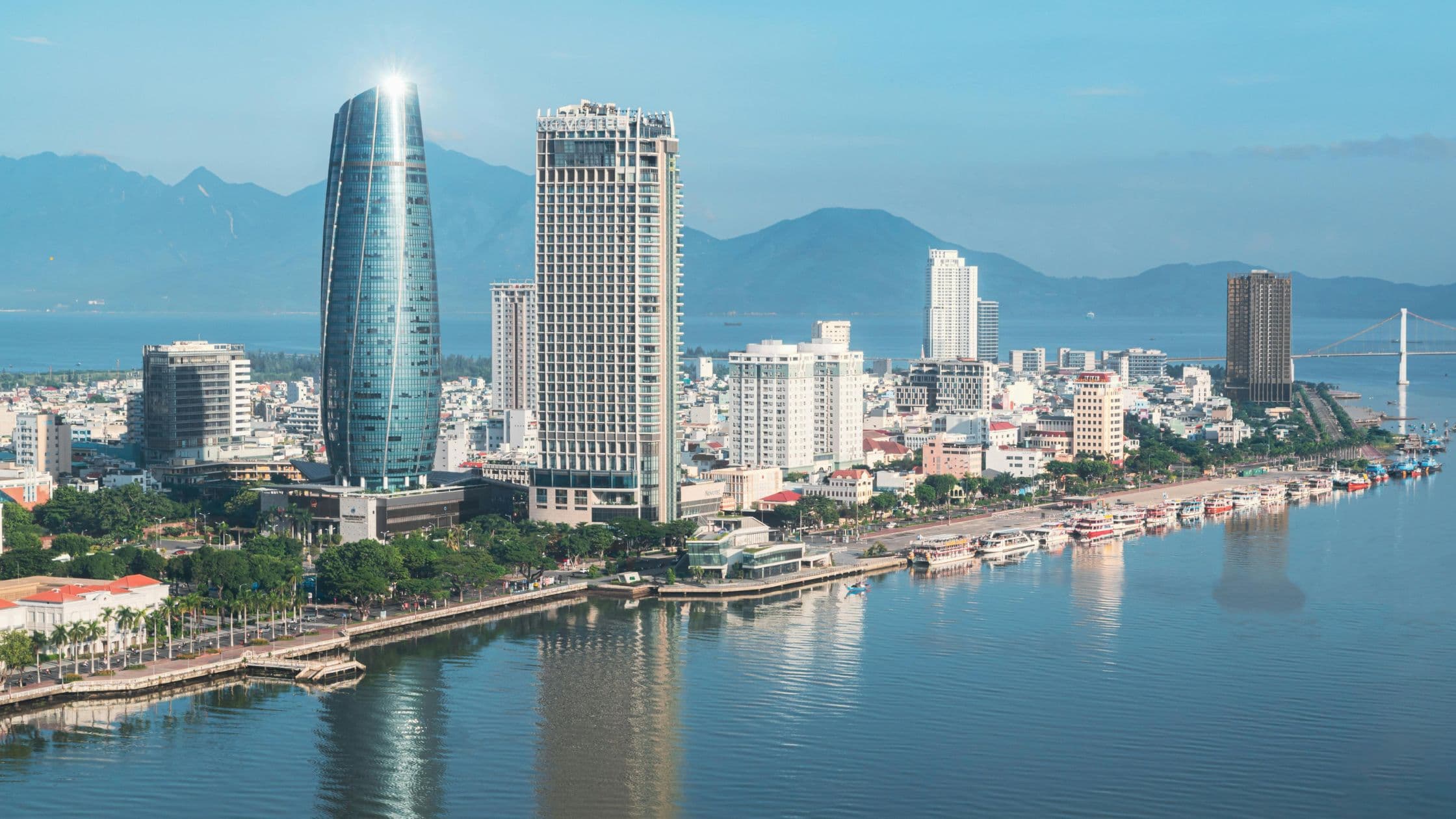
Da Nang has spent the last decade quietly turning into Vietnam's premium coastal market. The combination of My Khe Beach condominium stock, Son Tra peninsula villa estates and Sun Group's masterplan reach across the central coast has produced the country's most concentrated branded-residence and resort-residential pipeline outside Phu Quoc.
The buyer profile is distinct. Hong Kong, Singapore and Korean second-home buyers dominate the premium segment. The long-stay rental market is thinner than Saigon or Hanoi but anchored by remote-working professionals and a substantial Korean expat community in the southern beach corridor. Resale liquidity is improving but remains the sharpest watchpoint compared to more established Asian coastal markets.
02
The three corridors that matter
My Khe Beach
The 30-kilometre stretch of beachfront south of the Han River mouth, anchoring the Da Nang foreign-buyer condo market. Premium new launches USD 2,500 to 5,000 per square metre depending on sea-view orientation and building specification. Walking distance to a growing dining belt (Korean, Japanese, Western influences), beach club infrastructure and the international school cluster in An Thuong.
Son Tra peninsula
The protected forest peninsula on the northern edge of the city, anchored by the InterContinental Da Nang Sun Peninsula Resort. The premium villa market sits inside Sun Group and InterContinental masterplans on the peninsula's southern slopes. Typical villa transactions run USD 1.5 to 4 million for 3 to 5 bedroom configurations with ocean views. Marine-protected zoning limits new development which structurally supports values.
Hai Chau city centre
The central business district on the western bank of the Han River. Premium new launches USD 1,800 to 3,200 per square metre. Foreign-buyer activity is thinner here than on the beach corridor; most buyers in this segment are looking for long-stay rental yield to local corporate tenants rather than the second-home or capital-preservation play that dominates the beach.
03
Branded residences pipeline
Da Nang's branded-residence segment has grown from effectively zero in 2015 to one of the deepest pipelines in Vietnam. Active and committed operators include:
InterContinental Da Nang Sun Peninsula Resort (with branded villa component), Marriott (Le Meridien Da Nang Resort & Spa), Hyatt (Hyatt Regency Da Nang), Movenpick (Movenpick Resort Cam Ranh — north of Da Nang technically), and the Sun Group hospitality portfolio across multiple branded sub-properties.
Practical implications for foreign buyers: branded residence stock typically commands a 20 to 35 percent price premium over non-branded comparable beachfront product, in exchange for managed-rental yield infrastructure, operator-grade build quality and clearer resale narrative. The trade-off is that the management contract typically takes 50 to 60 percent of gross rental revenue.
04
Pricing 2026
My Khe Beach premium new launch: USD 2,500 to 5,000 per square metre. Sea-view oriented top third of the range; second-row inland units the bottom third.
Son Tra villa transactions: USD 1.5 million for 3-bedroom resort-style villas at the entry level, up to USD 4 million plus for premium Sun Group or InterContinental branded units. Resale market thinner than Phuket but firming.
Hai Chau city centre: USD 1,800 to 3,200 per square metre. Less foreign-buyer driven, more local corporate tenant focused.
Branded residence premium: Add 20 to 35 percent over non-branded comparable. The premium has widened since 2024 as the segment has matured.
05
The buyer profile
Da Nang's foreign-buyer cohort skews differently from HCMC and Hanoi. The Korean buyer presence is the largest single nationality bloc, particularly in the southern My Khe corridor where the Korean restaurant density, Korean-language services and direct flights to Seoul Incheon make the city function as a Korean second-home node. Hong Kong, Singapore and Taiwan buyers concentrate in the branded residence premium. Mainland Chinese buyers face additional outbound capital friction post-2020 and are less prominent than they were in the 2018 peak.
Remote-working professionals — particularly from Western Europe and the US — make up a growing share of the long-stay rental tenant pool. They typically rent before they consider buying. Resale activity in Da Nang is still driven more by the original investor cohort than by genuine secondary user demand, which is the structural maturation watchpoint.
06
Taxes and transaction costs
Vietnam's tax regime applies uniformly. There is no annual property tax on residential apartments. See the country-level Vietnam Buyer Guide for the full framework. Da Nang-specific note: branded-residence management-contract revenue runs through a defined Vietnamese operating entity which has tax implications for the foreign owner. Get this reviewed by a local tax advisor before signing.
07
Rental yields
Gross yields on My Khe Beach managed condos run 5 to 8 percent. Branded-residence managed product reaches 6 to 9 percent gross but the management contract takes the larger share. Owner-net yields after taxes, management fees and the November to March peak / April to October shoulder seasonality settle 3 to 5 percent in the managed-rental scenario.
Long-stay rental (12-month leases to remote workers, Korean expat families, multilateral staff) achieves slightly lower headline rent than seasonal short-stay but with materially lower vacancy and management overhead. The owner-net delta between the two models is often smaller than the gross headline suggests.
08
Common pitfalls
1. The branded-residence management contract. Read it before signing the SPA, not after. 50 to 60 percent management cut, mandatory pool contributions, restricted owner-use windows and exit clauses are all common.
2. Buying outside the branded ecosystem. Non-branded standalone villa purchases on Son Tra are very rare and frequently problematic. Stay inside masterplanned developments with registered foreign-eligible status.
3. Underestimating seasonal vacancy.April to October is the wet shoulder. Short-stay rental in this window can drop 40 to 60 percent below peak. The full-year yield calculation must average across both seasons.
4. Resale exit assumption. Da Nang resale market is still thin. Build a 5-year minimum hold assumption into your underwriting.
5. The nominee structure. Same warning as country-wide. Avoid.
09
Common questions about Da Nang property
- Why is Da Nang growing so fast as a foreign-buyer market?
- Three structural drivers. First, the international airport (Da Nang International) has expanded direct connectivity to over 20 cities including Seoul, Tokyo, Hong Kong, Singapore and Taipei. Second, Sun Group's masterplan reach across central Vietnam has anchored hospitality-grade infrastructure that the foreign-buyer segment can plug into. Third, the branded residence wave (InterContinental, Marriott, Hyatt) has given the segment institutional credibility it did not have five years ago. The market is still much smaller than Bali or Phuket but the trajectory is the steepest in Southeast Asia.
- What does USD 3,000 per square metre buy in Da Nang?
- On My Khe Beach: a two-bedroom of 80 to 95 sqm with sea view, fully furnished, in a managed building with pool and gym. On Son Tra peninsula: a smaller villa or villa-style suite of similar internal space but with garden or terrace access. Compared to Phuket at the same price point you get more square metres but a thinner secondary market and less mature property-management ecosystem.
- Can foreigners buy Son Tra villas?
- Yes, inside registered residential projects subject to the 10 percent per-ward villa cap. Most foreign-eligible Son Tra villas sit inside masterplanned developments operated by Sun Group, InterContinental Da Nang Sun Peninsula Resort or similar resort-residential frameworks. Stand-alone Son Tra plots are not available to foreign buyers as registered title.
- How does Da Nang compare to Phuket as a foreign-buyer destination?
- Da Nang pricing sits 30 to 50 percent below comparable Phuket product. The branded-residence pipeline is younger and thinner — Phuket has decades of operator history, Da Nang has perhaps eight years. Rental yields run slightly higher in Da Nang (5-8% gross) than Phuket prime beachfront (4-6%). The secondary market in Phuket is materially deeper, particularly for west-coast premium villas, which means resale liquidity is the structural Phuket advantage. Da Nang is earlier in the curve.
- What rental yields work for Da Nang condos?
- Gross yields run 5 to 8 percent on managed My Khe Beach condos, 6 to 9 percent on managed resort-condominium product inside Sun Group and InterContinental developments. Net yields after the 10 percent rental income tax above threshold, management fees (typically 15 to 25 percent of rent for serviced units) and the seasonal vacancy pattern settle 3 to 5 percent. Management operator quality is the swing factor.