
Hua Hin · Foreign Buyer Guide
Buying property in Hua Hin as a foreigner
The Gulf-coast retreat of the Thai royal family, the country's most mature golf-estate market, and a quietly significant second-home destination. A complete editorial guide for the foreign buyer.
01
Why Hua Hin still matters
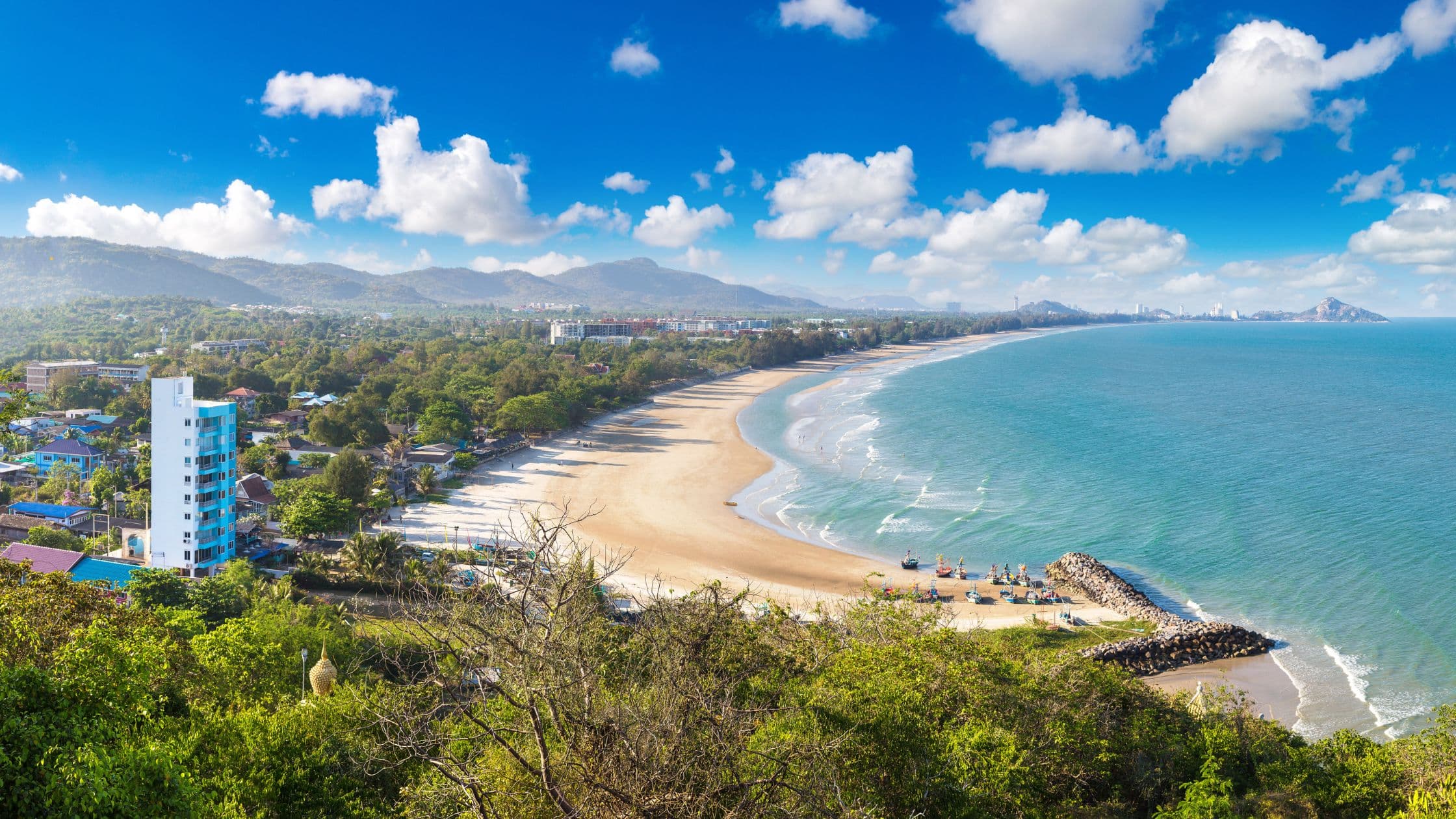
Hua Hin sits three hours south of Bangkok along the western shore of the Gulf of Thailand. It is the country's most established weekend-and-second-home market and the summer-retreat of the Thai royal family since 1926. The royal presence has shaped the town's character toward a calmer, more residential and more conservative tone than Pattaya. The same factor has anchored a continuous cycle of state-led infrastructure investment along the corridor.
The foreign buyer base in Hua Hin is concentrated in long-stay Northern European retirees, with particularly strong Scandinavian, German, British and Dutch representation. A second large pool is Bangkok-based Thai professionals with weekend homes. The structural growth opportunity is the remote-worker and second-home buyer cohort, drawn by the slower pace and the relative affordability compared to Phuket or Samui.
What sets Hua Hin apart is the dominance of land-and-villa product over condominium, the maturity of the golf-estate segment, and the meaningfully shorter distance from Bangkok than the Andaman alternatives. For foreign buyers who want a Thailand second home that pairs with a Bangkok primary residence, Hua Hin is structurally the most convenient option.
Hua Hin does not get bought on impulse. Most buyers know the town for a decade before they sign anything. That is a feature, not a bug.
02
The foreign-ownership rules
The Thai legal framework applies in Hua Hin as it does everywhere else. A foreigner may own a condominium unit on freehold, in their own name, subject to the 49 percent per-building foreign quota. Foreigners cannot own land directly. Houses, villas and golf-estate properties are typically acquired through long-term leasehold (thirty years with contractual renewals) or via a Thai company structure where the foreigner holds 49 percent direct equity plus controlling preference shares.
In Hua Hin's mature golf-estate segment the long-term lease is the standard structure. Most established estates have years of experience handling foreign-buyer documentation, and the lease templates are well-documented. Bespoke land purchases for custom villas are more commonly structured through the Thai-company route.
03
Golf estates and villa structures
Hua Hin and the adjacent Cha-Am district carry one of Thailand's densest concentrations of golf-anchored residential estates. Black Mountain, Banyan, The Majestic Creek, Springfield Royal Country Club, Royal Hua Hin Golf Club, Palm Hills, Imperial Lake View, Sea Pines and a dozen further estates form the inland golf belt. Most operate residential components alongside the course, with villa estates ranging from THB 8 million entry-tier to THB 60 million plus for high-end branded product.
What a golf-estate purchase looks like
A typical golf-estate villa transaction comes bundled with course-membership rights, common-area amenities (pool, gym, clubhouse, often a restaurant) and an optional rental management programme. The lease document for the land sits separately from the freehold ownership of the villa structure. Verify what is included with the property and what is paid separately (golf membership in particular varies between estates).
Course-side versus inland villas
Villas directly fronting the course typically price 10 to 25 percent above inland properties of the same size in the same estate. The premium reflects view, daylight and resale liquidity. For buyers who do not play, an inland villa offers more value for the same building spec.
The long-term lease in detail
A standard structure is thirty years initial term with two contractual thirty-year renewals. Thai law does not statutorily guarantee renewal; the renewals are contractual promises that depend on document quality and the lessor's continued existence. The lease must be registered at the Prachuap Khiri Khan Provincial Land Office (Hua Hin sub-office) to be enforceable beyond three years.
04
The corridors that hold value
Hua Hin is geographically compact but the foreign-buyer market splits across distinct corridors. The central town and beachfront is the historic core. The southern corridor toward Khao Takiab, Khao Tao and Pranburi is quieter and more residential. The inland golf belt sits west of the town. Cha-Am to the north is more local Thai feel and offers value.
Hua Hin town centre
The historic core. The corridor running from the railway station south along the beachfront (Soi 6 through Soi 102 area) is the established town core. Condominium product clusters here. Restaurants, the night market, the weekly Cicada arts market and the central beach are all within walking distance. Pricing for two-bedroom condominiums typically runs THB 4 million to 12 million depending on building, view and floor.
Khao Takiab and the south beach
The southern corridor. Khao Takiab (monkey hill) marks the southern boundary of the central beach. Beyond it the coast continues quieter and more residential. A mix of branded condominium product (Wan Vayla, the Marrakesh Residences, Veranda Resort residences) and villa estates. Pricing is broadly similar to the central corridor but with quieter access to the beach.
Khao Tao and Pranburi
The residential south. Khao Tao village and Pranburi further south anchor the genuinely residential southern corridor. Foreign-buyer interest concentrates on villa estates inland and along the coast. Pranburi carries some of the most established long-stay-European communities, particularly Scandinavian and German. Pricing for villa estates here runs THB 8 million to 25 million depending on estate and view.
Cha-Am to the north
The value-side corridor. Cha-Am to the north of Hua Hin is more local Thai feel, with a quieter beach and pricing roughly 15 to 25 percent below Hua Hin proper for equivalent product. Several golf courses anchor the inland Cha-Am area. For value-focused buyers willing to accept a less developed restaurant and retail scene, Cha-Am can deliver strong value.
The inland golf belt
The estate corridor. The inland belt west of the AH4 highway hosts the major golf estates (Black Mountain, Banyan, Palm Hills, Springfield, The Majestic Creek and others). Villa product here is the dominant foreign-buyer segment. Pricing for three-bedroom estate villas typically runs THB 10 million to 35 million, with course- fronting and branded product reaching higher.
05
Visa options
Owning property does not confer the right to reside in Thailand. The visa routes are the same nationally.
Retirement visa
Available to applicants aged 50 and over, with a Thai bank balance of THB 800,000 or proof of THB 65,000 monthly income. Annual renewal. This is by far the most common visa among Hua Hin foreign residents, given the age profile of the long-stay European retiree pool.
Long-Term Resident (LTR) Visa
The 10-year LTR is the strongest current option for higher-income foreigners under 50 or with sufficient income to qualify under other categories. Particularly well-suited to remote-working buyers basing themselves in Hua Hin while working internationally.
Thailand Privilege visa
Membership-based long-stay programme. Fees from approximately THB 900,000 for 5 years to several million baht for 20-year memberships. Includes concierge and government liaison. Common among Hua Hin buyers who do not meet retirement or LTR thresholds.
06
The buying process
Hua Hin purchases typically run six to ten weeks from signed reservation to title transfer at the Hua Hin sub-office of the Prachuap Khiri Khan Provincial Land Office.
1. Reservation agreement. Typically THB 100,000 to 300,000 deposit. Read the deposit conditions carefully.
2. Due diligence by Thai counsel. Land title verification, foreign quota check for condos, developer or estate verification, lease document review.
3. Sale and purchase agreement. Standard Thai SPA. For villas, paired with the long-term lease document for the land.
4. Foreign Exchange Transaction Form (FETF). Required for freehold condominium purchases. Purchase capital must be wired into Thailand from overseas in foreign currency.
5. Land Office transfer. Title and lease registration at the Hua Hin sub-office.
07
Taxes and recurring costs
Hua Hin taxes are the same as the rest of Thailand. The one-time costs at purchase are the transfer fee (2 percent of Land Office assessed value), stamp duty or specific business tax, and withholding tax on the seller side. Annual recurring costs include the Land and Building Tax, common-area and golf-estate fees (typically THB 4,000 to 15,000 per month for premium estates, plus separate golf membership fees in some estates), and personal income tax on rental income.
08
Common pitfalls
Coastal beach erosion. Some stretches of the central Hua Hin beachfront have experienced significant erosion over the past two decades. Some beachfront condominium values have softened where shoreline recession has been pronounced. Always inspect the actual beach in front of the building and ask agents about long-term shoreline behaviour.
Golf-membership separation from villa purchase. In some estates the golf membership is included with the villa; in others it is sold separately and is a substantial additional cost. Verify what the purchase price includes before signing.
Unregistered leases. A 30-year lease must be registered at the Land Office to be enforceable beyond three years. Always verify registration before final payment.
Renewal mechanics.The two thirty-year renewals are contractual promises by the lessor, not statutory guarantees. Renewal terms must be specific, unambiguous and supported by the lessor's continued economic interest.
Older condominium common areas.Some older Hua Hin condominium buildings have under-funded common-area maintenance budgets. Verify the building's sinking fund and any pending major repairs before acquiring older condo product.
09
Rentals, yields and the seasonal market
Hua Hin yields are lower than Phuket or Samui due to a shorter peak-season window and a smaller short-stay international tourist pool. Gross rental yields on villas typically run 4 to 7 percent. Net yields after management fees usually settle 3 to 5 percent. The high season runs roughly November through February, with the Bangkok weekender market sustaining occupancy in the shoulder months.
For most Hua Hin foreign buyers, the property is an owner-occupier or owner-occupier-plus-occasional-rental rather than a dedicated buy-to-let investment. The yield is real but the case for Hua Hin is rarely pure investment.
Condominium yields run 3 to 5 percent gross for long-stay rental, with some short-stay holiday yield potential in the central corridor during peak season.
10
Lifestyle and connectivity
Hua Hin's lifestyle infrastructure has matured significantly over the past decade. The Bluport shopping mall, the Cicada night market, the Chatchai Market, a growing dining scene (Hua Hin's restaurant cluster has been recognised increasingly by the regional press), and established international medical facilities (Bangkok Hospital Hua Hin, San Paulo Hospital) anchor a town that lives genuinely well year-round.
International schools are smaller in number than Phuket or Bangkok but established. Hua Hin International School and International School of Hua Hin are the main names. The school presence supports a small but growing foreign-family resident community.
Connectivity to Bangkok is the structural advantage. The AH123 motorway connection makes the Bangkok-Hua Hin weekend pattern straightforward for both Thai and foreign buyers. Train service via the State Railway of Thailand (Hua Hin railway station is one of Thailand's most photographed) takes around two and a half hours, with the new high-speed rail link in late planning stages. The local airport (Hua Hin Airport, HHQ) is small and domestic-only; Bangkok Suvarnabhumi remains the practical international gateway.
11
Common questions about Hua Hin property
- Can a foreigner own property in Hua Hin?
- Yes. The legal framework is the same as the rest of Thailand. Foreigners can own a condominium unit outright on freehold, subject to the 49 percent per-building foreign quota. Foreigners cannot own land directly, so houses and villas are acquired through long-term leasehold structures or via a properly structured Thai company.
- Is Hua Hin a villa market or a condo market?
- Predominantly a villa and golf-estate market. Hua Hin and the adjacent Cha-Am district carry one of Thailand's densest concentrations of golf-anchored residential estates. Condominium product exists along the central beachfront and in the Soi 80 to Khao Takiab corridor, but most foreign buyers acquire villas, often within branded golf estates.
- How long does it take to reach Hua Hin from Bangkok?
- Around three hours by car along the AH123 motorway, or two hours by train via the State Railway of Thailand. There is no commercial airport in Hua Hin. The nearest international airports are Bangkok (Suvarnabhumi BKK, around three hours away by car) and the much smaller Hua Hin Airport (HHQ), which has limited domestic-only operations.
- What is the foreign buyer profile in Hua Hin?
- Hua Hin attracts a particularly stable European long-stay retiree market, with strong Scandinavian, German, British, Dutch and Swiss representation. Domestic Thai weekenders from Bangkok form a second large pool, particularly for higher-end golf estate properties. There is a smaller but growing remote-worker and second-home buyer base.
- Why does the Thai royal family matter for Hua Hin property?
- Klai Kangwon, the Thai royal family's summer palace, has been in Hua Hin since 1926. The royal presence has shaped the town's character toward a quieter, more residential and more conservative tone than Pattaya. Land use restrictions in certain corridors near the palace and along the central beachfront are stricter than elsewhere in Thailand. The royal presence is also a structural driver of the local infrastructure investment cycle.
- What yields can a Hua Hin villa generate?
- Gross rental yields on Hua Hin villas typically run 4 to 7 percent, lower than Phuket or Samui due to a shorter peak rental season and a smaller short-stay tourist pool. Net yields after management fees usually settle 3 to 5 percent. Owner-occupier-plus-occasional-rental is the more common Hua Hin model rather than dedicated buy-to-let villa investment.
- What taxes apply when buying property in Hua Hin?
- Same as the rest of Thailand. A 2 percent transfer fee, either 0.5 percent stamp duty or 3.3 percent specific business tax (the latter when the seller has held the property under five years), and graduated withholding tax on the seller. Annual costs include the Land and Building Tax, common-area fees for villa estates, and personal income tax on rental income.
- Do I need to worry about flooding or coastal erosion in Hua Hin?
- Hua Hin has historically been less flood-prone than Bangkok and the central plain, but coastal erosion has affected stretches of the central beachfront over the past two decades. Some beachfront condominium values have softened where shoreline recession has been pronounced. Inland villas and golf-estate properties are generally insulated from these dynamics. Always inspect the relevant beach and ask local agents about long-term shoreline behaviour.
Other Thailand destinations
Bangkok
The deepest condo market in Southeast Asia and the foreign-buyer capital of Thailand.
Read guide →
Phuket
The Andaman flagship: branded residences, west-coast villas and Thailand's deepest foreign-buyer market.
Read guide →
Pattaya
Highest condo yields in Thailand, marina-lifestyle and the EEC growth corridor.
Coming soon