
Koh Samui · Foreign Buyer Guide
Buying property on Koh Samui as a foreigner
The Gulf of Thailand's most established island market, a freehold villa economy at scale, and a post-quota condominium wave just beginning. A complete editorial guide for the foreign buyer.
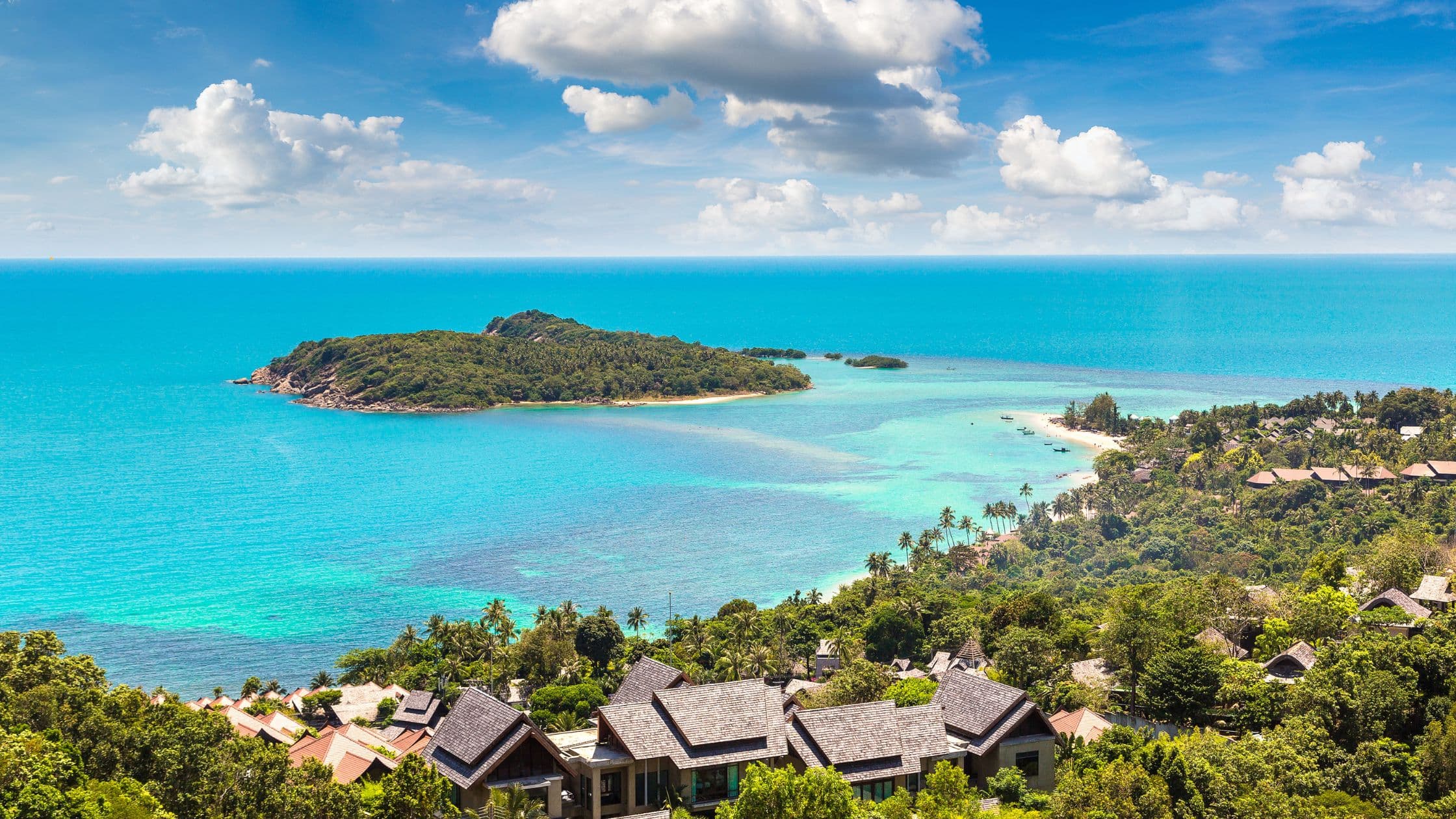
01
Why Koh Samui still matters
Koh Samui is Thailand's second-tier island that has quietly built a first-tier foreign-buyer market. Direct international flights through Bangkok Airways' USM hub, a deep wellness and hospitality economy, and a foreign-resident population that has been compounding for three decades have produced one of the country's most resilient holiday-home markets.
The structural story of recent years has been the branded-residence acceleration. Six Senses Samui, the Conrad Koh Samui residences, the W Koh Samui residences, Four Seasons private residences at Laem Yai and a small but growing pipeline of further brands have all added inventory or pipeline projects. Pricing for sea-view villas in established northeastern and western estates has held remarkably well through Thailand's broader 2025 slowdown, supported by the cash-buyer character of the Samui pool.
What sets Samui apart from Phuket is scale and tone. The island is smaller, the foreign-resident community more long-stay than holiday-home, and the lifestyle infrastructure weighted toward wellness, yoga, slow-living and culinary rather than nightlife. For buyers who want a beach-side second home that genuinely feels residential, Samui is often the better fit.
Phuket buyers want a villa. Samui buyers want a home. The legal mechanics are the same. The decision-making takes longer here, and that is usually a good thing.
02
The foreign-ownership rules
The Thai legal framework is the same across the country. A foreigner can own a condominium unit outright on freehold, in their own name, with the same title as a Thai national, subject to the 49 percent per-building foreign quota. The quota applies to total saleable floor area in a building, not individual units. In Samui's newer foreign-oriented condominium projects (Bophut, Choeng Mon, Chaweng Noi) the quota typically fills relatively easily; mid-market local buildings often have ample quota.
Foreigners cannot own land directly. Houses, villas and detached residences are typically acquired through long-term leasehold (thirty years initial term, contractual renewals) or via a Thai company structure that holds the land with the foreigner as 49 percent shareholder plus controlling preference shares.
Condominium versus villa
The condominium share of foreign-buyer Samui transactions has historically been small but is growing as new developer projects target the entry-tier foreign buyer who wants freehold simplicity. For pure investors who want hands-off ownership, condos in the Bophut and Choeng Mon corridor are the simplest route. For owners who plan to live or holiday on the island, villas dominate the choice set.
03
Villa ownership structures
A Samui villa transaction looks identical in structure to a Phuket one, but the documentation discipline of the local developer pool is more variable. Samui has both institutional developer products with well-documented long-term leases and bespoke land deals where the buyer must drive the documentation quality through their own counsel. Choose lawyers who know Samui specifically.
The long-term lease in detail
A standard structure is an initial thirty-year lease with two contractual renewals each of thirty years. Thai law does not statutorily guarantee renewal; the renewals are contractual promises that depend on the lessor's continued existence and willingness, plus document enforceability. The lease must be registered at the Surat Thani Provincial Land Office (Koh Samui sub-office) to be enforceable beyond three years.
Things to verify before signing: clean land title, the lessor is a stable legal entity, registration at the Land Office actually happens (not just promised), renewal terms are specific and unambiguous, transfer rights to your heirs are explicit, and dispute resolution mechanisms are workable from your home country.
The Thai company structure
The Thai limited company route is more common on Samui than people assume, particularly for buyers building custom villas on bespoke land plots in Choeng Mon, Bang Por or the west coast. You hold 49 percent direct equity, controlling preference shares give you board majority, and the company owns the land. The company must file annual tax returns and demonstrate genuine economic activity. Nominee Thai shareholders without genuine economic interest are illegal under current enforcement guidance.
This structure offers more long-horizon flexibility (no renewal clock) but requires more ongoing documentation discipline. The annual cost of maintaining the company, including accountant fees and tax filings, runs roughly THB 30,000 to 60,000 per year.
04
The corridors that hold value
Samui is geographically smaller than Phuket and the foreign buyer markets concentrate in a handful of corridors. The northeast is the established foreign-resident heart of the island. The west coast carries the premium sunset-view villa market. The south and the southeast offer value and a more local Thai feel. Chaweng is the volume tourism centre, useful for yield-focused condo buyers.
Bophut and Fisherman's Village
The northeast anchor.Bophut Beach and the Fisherman's Village commercial strip form Samui's most established foreign-buyer corridor. Restaurants, cafes, weekly Friday-night markets and a long beach front anchor the village. The hinterland behind Bophut hosts the densest concentration of villa estates on the island. Pricing for three-bedroom sea-view villas typically runs THB 18 million to 45 million depending on view and estate.
Choeng Mon and Plai Laem
The eastern premium pocket. Choeng Mon, the small curve of beach just east of the airport, hosts the Six Senses Samui, the Tongsai Bay and a cluster of premium branded villa estates. Plai Laem to the south carries the Big Buddha temple corridor and more standalone estates. Pricing here is among the highest on the island, with branded residences and large-format villas pushing THB 60 million and above for trophy product.
Chaweng and Chaweng Noi
The volume tourism centre.Chaweng is Samui's mass-tourism corridor, with the longest beach, the densest hotel inventory and the loudest nightlife. Chaweng Noi to the south is quieter, with hillside villa product and ocean views over a calmer bay. Foreign-buyer interest concentrates on yield-oriented condominium product in Chaweng proper and premium villas on the Chaweng Noi headland.
Lamai
The southeast long-stay corridor.Lamai is Samui's second-tier resort area, smaller and more residential than Chaweng. Strong long-stay European resident base, particularly Italian, French and German. Pricing is more accessible than the northeast corridor, yields are reasonable, and the lifestyle is genuinely residential. Banyan Tree Samui occupies the southern headland.
Maenam and Bang Por
The north-coast value corridor. Maenam runs along the calm northern coast facing Koh Phangan. Quieter, more local Thai feel, with a growing foreign-resident community. Bang Por to the west of Maenam hosts the W Samui residences and a number of bespoke villa estates. Sunset views over the Phangan side. Pricing is below the northeast corridor and value remains.
Lipa Noi and Taling Ngam
The west-coast sunset corridor.Lipa Noi and Taling Ngam on the west coast carry the island's highest concentration of premium sunset-facing villa estates. Conrad Koh Samui anchors the corridor at Taling Ngam. The west coast is quieter than the northeast and the lifestyle is more remote-residential, with the ferry pier to Donsak (mainland Surat Thani) as the practical anchor. Pricing is premium for sea-view product.
Laem Yai and the north-west
The ultra-premium tip.Laem Yai at the northwestern tip hosts the Four Seasons Koh Samui and the adjacent Four Seasons Private Residences, the island's most established ultra-premium estate. A small handful of bespoke private estates make up the rest of the corridor. Smaller buyer pool, but very stable values.
05
Visa options
Owning property on Samui does not give you the right to reside in Thailand. The visa routes are the same as the rest of the country.
Long-Term Resident (LTR) Visa
The 10-year LTR is the strongest current option for high-income foreigners. Includes a digital work permit, 17 percent flat personal income tax rate on Thai-source income for qualifying skilled professionals, and overseas income tax exemptions for several categories. Particularly well-suited to remote-working buyers basing themselves on Samui.
Thailand Privilege visa
Membership-based long-stay programme administered by the Tourism Authority of Thailand. Fees from approximately THB 900,000 for 5 years to several million baht for 20-year memberships. Includes concierge and government liaison. Common among Samui owners who do not meet LTR thresholds.
Retirement visa
Available to applicants aged 50 and over, with a Thai bank balance of THB 800,000 or proof of THB 65,000 monthly income. Annual renewal. The most common visa among established Samui foreign residents.
06
The buying process
A Samui purchase typically runs six to ten weeks from signed reservation to title transfer at the Surat Thani Provincial Land Office, with some flexibility around the Samui sub-office processing times.
1. Reservation agreement. Typically THB 100,000 to 500,000 deposit. Read carefully before signing, including the conditions under which the deposit becomes non-refundable.
2. Due diligence by Thai counsel. Land title verification, foreign quota check for condos, developer or lessor verification, lease document review, site survey. Two to four weeks for serious due diligence.
3. Sale and purchase agreement. For condos, a freehold or leasehold SPA. For villas, the SPA pairs with a separate lease document for the land or with share transfer documents for the Thai company structure.
4. Foreign Exchange Transaction Form (FETF). Required for freehold condominium purchases. Purchase capital must be wired into Thailand from overseas in foreign currency and converted to baht by a Thai bank, which issues the FETF. The Land Office requires it for the freehold transfer.
5. Land Office transfer. Title is registered at the Samui sub-office of the Surat Thani Provincial Land Office. Long-term leases are registered the same way. Both parties or their authorised representatives attend. Transfer fee and taxes paid in cash or bank draft.
07
Taxes and recurring costs
Samui taxes are the same as the rest of Thailand. The one-time costs at purchase are the transfer fee (2 percent of Land Office assessed value), either stamp duty (0.5 percent) or specific business tax (3.3 percent, applicable when the seller has held the property under five years), and withholding tax on the seller side. By custom these are split between buyer and seller, though allocation is negotiable.
Annual recurring costs include the Land and Building Tax (single-digit per thousand on assessed value, modest in absolute terms), common-area fees for villa estates (typically THB 25 to 50 per square metre per month for premium estates, plus separate pool and garden charges in some structures), and personal income tax on rental income. For Thai-company villa structures, allow THB 30,000 to 60,000 per year for accountant and tax filing fees.
08
Common pitfalls
Unregistered leases. A 30-year lease must be registered at the Land Office to be enforceable beyond three years. Some Samui sales galleries promise registration that never happens. Verify the registration document before final payment.
Vague renewal mechanics. Two thirty-year renewals are not statutorily guaranteed. They are contractual promises by the lessor that depend on document quality and lessor continuity. Renewal clauses must be specific, with clear renewal triggers and unambiguous terms.
Nominee Thai shareholders. Using Thai nationals as nominees in a company structure (without genuine economic participation) is illegal under current enforcement guidance. The risk has been rising. Use specialist counsel and either structure genuine Thai participation or use the long-term lease route.
Pre-launch deposit risk.Samui's developer pool ranges from institutional to undercapitalised. Verify developer financing, completion history and bank arrangements before committing pre-launch deposits. Deferred or cancelled mid-build projects are the realistic risk with undercapitalised developers.
Water and infrastructure. Some Samui villa estates rely on private water systems, septic tanks and standalone electrical infrastructure. Verify what is connected to municipal services and what is private, and what the ongoing maintenance arrangements are. This affects long-term cost and resale.
09
Rentals, yields and management
Samui rental economics are stronger than Bangkok and comparable to or slightly above Phuket on a like-for-like villa basis. Premium sea-view villas in established northeastern and western estates deliver 5 to 7 percent net yield to the owner with active management programmes. Owner-direct rental via Airbnb or villa-direct platforms can push gross yields to 8 to 12 percent with substantially more owner workload.
Branded-residence pools (Six Senses, W Samui, Conrad, Four Seasons) deliver 4 to 6 percent net with full operator management and capped owner usage (typically 30 to 60 nights per year, peak season blocked).
Condominium yields run 4 to 6 percent gross for long-stay residential rental, 5 to 8 percent for short-stay holiday rental in foreign-buyer condo buildings. Lower than villa yields but with passive management and easier remote ownership.
10
Lifestyle, schools and getting there
Samui's international school presence is smaller than Phuket's but established. The main international schools are Panyadee British International School, the International School of Samui (ISS) and PrePrep International School. The school cluster supports full-time foreign-family residency on the island but is not comparable in depth to Phuket or Bangkok.
Medical infrastructure includes Bangkok Hospital Samui and the Samui International Hospital, both with strong foreign-resident programmes. Complex cases are referred to Bangkok or Phuket.
Getting on and off the island is the practical constraint of Samui life. The USM airport is operated principally by Bangkok Airways, which prices its USM routes at a premium. Alternative routes via Surat Thani airport plus ferry add travel time but reduce cost. The ferry from Donsak (mainland Surat Thani) to Nathon (Samui) takes 90 minutes and runs throughout the day; private yachts and speedboats fill the ultra-premium segment.
Lifestyle infrastructure is wellness-weighted compared to Phuket. The island hosts one of Asia's deepest concentrations of detox retreats, yoga schools, vegan and plant-based dining, and spa facilities. Sailing, kite surfing, and golf (Santiburi Samui Country Club) round out the recreational set. The pace is meaningfully slower than Phuket. Many full-time foreign residents cite this as the primary reason they chose Samui over the Andaman alternative.
11
Common questions about Koh Samui property
- Can a foreigner own property on Koh Samui?
- Yes. The legal framework is the same as the rest of Thailand. Foreigners can own a condominium unit outright on freehold, subject to the 49 percent per-building foreign quota. Foreigners cannot own land directly, so villas and houses are typically acquired through long-term leasehold structures or via a properly structured Thai company.
- Is Koh Samui a villa market or a condo market?
- Predominantly villas. The condominium market is smaller and more recent than Phuket's, concentrated around Choeng Mon, Bophut and Chaweng. Most foreign buyers on Samui are buying private homes rather than yield instruments. Branded-residence inventory is growing but smaller than Phuket's branded pipeline.
- How do I get to and from Koh Samui?
- Koh Samui has its own international airport (USM), operated principally by Bangkok Airways which holds a long-standing operational arrangement. Direct flights connect to Bangkok, Singapore, Hong Kong, Kuala Lumpur and Chengdu. Alternative routes include flying to Surat Thani (URT) and taking the ferry, or flying via Krabi or Phuket and continuing onward. The Bangkok Airways USM premium prices the direct route higher than Phuket's airport.
- What is a Thai-company villa structure and is it legal?
- A Thai limited company that holds the land underneath your villa is one of the two main routes for foreign-buyer villa ownership. You hold 49 percent of the shares directly, with controlling preference shares giving you board majority, and the company owns the land. This structure is legal if the Thai shareholders have genuine economic participation. Using nominees (Thai nationals who hold shares without economic interest) is illegal under current Thai enforcement guidance. Speak to a specialist Thai property lawyer before structuring anything this way.
- What yields can a Koh Samui villa generate?
- Gross rental yields on Samui villas typically run 5 to 9 percent depending on location, view and rental programme. Premium sea-view villas in established estates with active management programmes deliver 5 to 7 percent net to the owner after fees. Owner-direct rental via Airbnb or villa-direct channels can deliver 8 to 12 percent gross but with higher owner workload. Branded-residence pools deliver 4 to 6 percent net with operator-managed bookings.
- Where do most foreign buyers actually purchase on Koh Samui?
- The northeast corridor running from Bophut through Choeng Mon and Plai Laem carries the highest concentration of foreign-buyer villa estates and the established expat community. The west coast from Lipa Noi to Taling Ngam carries the premium sunset-side villa market. The southeast around Lamai is more mid-market with a strong long-stay European resident base.
- Do I need to register a long-term lease with the Land Office?
- Yes, for any lease over three years. A long-term lease in Thailand must be registered at the relevant Provincial Land Office to be enforceable beyond three years and against third parties. Unregistered long-term leases are a common pitfall on Samui. Always verify the registration document before final payment.
- What taxes apply when buying property on Koh Samui?
- Same as the rest of Thailand. A 2 percent transfer fee, either 0.5 percent stamp duty or 3.3 percent specific business tax (the latter applies when the seller has held the property under five years), and graduated withholding tax on the seller. Annual costs include the Land and Building Tax, common-area fees for villa estates, and personal income tax on rental income.
Other Thailand destinations
Bangkok
The deepest condo market in Southeast Asia and the foreign-buyer capital of Thailand.
Read guide →
Phuket
The Andaman flagship: branded residences, west-coast villas and Thailand's deepest foreign-buyer market.
Read guide →
Hua Hin
The royal retreat: long-stay villas, mature golf estates and second-home buyers.
Coming soon